
Masthishka Maranam (2026): Neo-Kochi Is Vivid, But The Film Stumbles


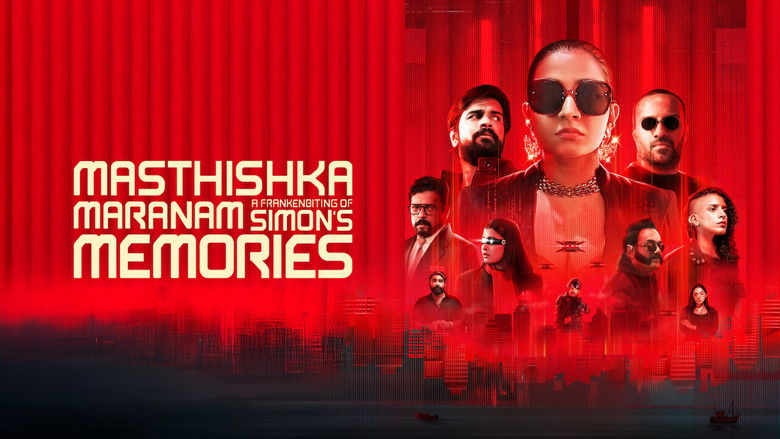
A grieving father plugs into a virtual memory game inside Neo-Kochi, a future city choking on class divide, AI propaganda, and commodified grief, only to find himself obsessed with a woman named Frida Soman and pulled into illicit memory trading. The premise crackles with intelligence, and for stretches, Krishand’s film delivers exactly the kind of jagged, funny, unsettling satire it promises, before its own contradictions catch up with it.
Rajisha Vijayan Brings Frida Soman Alive Even When the Script Forgets Her
Rajisha Vijayan is the most watchable person in this film, grounding Frida Soman with a quiet complexity that the screenplay doesn’t always earn. She holds scenes together that would otherwise drift into caricature. The film’s critique of voyeurism and objectification lands hardest precisely when the camera is on her.
Bimal Raj Carries the Film’s Emotional Weight on Uncertain Ground
Bimal Raj’s grieving father is the moral and narrative anchor, a man whose obsession with a virtual stranger blurs memory, guilt, and reality into something genuinely uncomfortable. The film is at its most focused when it stays close to his unraveling. But performances across the ensemble are uneven, and some actors visibly strain under the demands of exaggerated, heightened characters.

Krishand Builds a Convincing World, Then Ignores Half of It
The direction has real ambition, technically, the art direction builds a convincing Neo-Kochi that earns its dystopian credentials. Visually, this is a film that knows what it wants to look like. The screenplay, however, opens with extended narration on class divide and capitalism that the rest of the story simply never pays off, leaving a peculiar structural hollow at the film’s foundation.
Vishnu Agasthya and Divya Prabha Are the Film’s Most Surprising Asset
I didn’t expect the dialogue exchanges between Vishnu Agasthya and Divya Prabha to be the sharpest writing in a film built around speculative fiction, but here we are. Their scenes carry a rhythm and wit that the rest of the screenplay reaches for inconsistently. Niranjan and Suresh Krishna also perform superbly, though neither gets the material to fully distinguish themselves.
For more Malayalam sci-fi and genre films worth your time, bollyflix.me.uk covers Malayalam thrillers and dystopian dramas that push the language’s cinematic boundaries.
The Courtroom Scenes Land; The Comedy Does Not Always Follow
The courtroom sequences are sharp, funny, and function as the film’s most direct social satire, the kind of scene that reminds you exactly what Masthishka Maranam is capable of when it’s firing. But the comedy elsewhere is wildly inconsistent; some bits cross from quirky into genuinely cringe, and the pacing suffers for it. The music and background score, however, are extraordinary throughout, one of the cleaner creative decisions in an otherwise erratic film.
The film had a limited theatrical run from March 6, 2026 before arriving on Netflix on March 27, and its audience reception largely reflects the split personality of the film itself. Fans of the genre responded warmly to the world-building and the lead performances, while complaints about uneven tone and irrelevant setup elements were consistent.
Masthishka Maranam lands somewhere between inspired and incomplete. At 2 hours 26 minutes, it asks for patience it hasn’t always earned. The braindance concept borrowed from cyberpunk fiction, filtered through Malayalam social comedy, is genuinely interesting, but the film’s Frankenbiting of that concept results in a structure where the pieces don’t fully cohere.
Catch it on Netflix rather than seeking out the limited theatrical run, the OTT format suits its uneven energy, and the extraordinary background score deserves decent audio. If you’re a fan of dystopian satire and can tolerate tonal inconsistency, there’s enough here to reward the watch. If you need precision, this one will frustrate you.
Masthishka Maranam deserves credit for its ambition and its world, even if that world collapses under screenplay contradictions, a 2.5 out of 5 that lands as an interesting failure more than a satisfying film.
If this kind of Kerala genre experiment intrigues you, the review of Prathichaya examines another recent Malayalam film that struggled to match its own ambition.
For another look at Malayalam films that promise more than they deliver, the Band Melam review covers a very different genre facing the same structural honesty problem.
Ankit Jaiswal is the Chief Author, covering Indian cinema and OTT releases with honest, no-filler criticism. An SEO strategist by background, he brings a research-driven approach to film writing, cutting through hype to tell you exactly what's worth your time.